
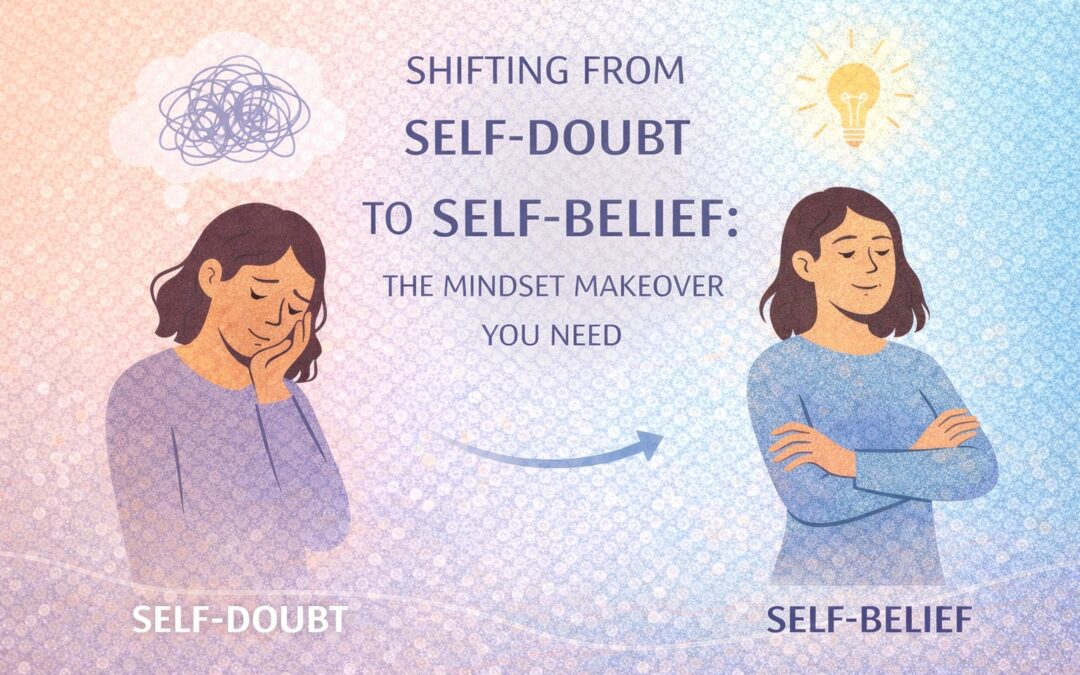
Self-doubt is something nearly everyone experiences. It’s that inner voice that tells you that you’re not good enough, smart enough, or talented enough. It shows up when you’re faced with new challenges, unfamiliar situations, or when you compare your journey to others’. While self-doubt is a common experience, it’s not something you have to live with forever. With intention, awareness, and consistent practice, you can shift from self-doubt to unshakable self-belief and develop the kind of mindset that supports growth, confidence, and authenticity.
What Is Self-Doubt and Why Does It Arise?
Self-doubt is rooted in fear fear of failure, rejection, judgment, or the unknown. It often develops from past experiences, comparison with others, or internalized criticism. For some, self-doubt shows up as perfectionism. For others, it creeps in as hesitation or a fear of taking risks.
Importantly, self-doubt does not mean you lack ability. It simply means that your inner narrative hasn’t caught up with your potential yet. And narratives can be rewritten.
Why Self-Belief Matters
Self-belief is not about arrogance. It’s a quiet confidence that allows you to take action even when you feel fear. It enables you to recover from setbacks, try again after failure, and trust your intuition. Self-belief makes life clearer and more purposeful, because you stop living to prove yourself to others. Instead, you act from a place of trust in your own worth.
The journey from self-doubt to self-belief is a mindset makeover changing how you think about yourself, your abilities, and your potential.
1. Recognize and Acknowledge Your Inner Voice
The first step in shifting your mindset is becoming aware of your inner dialogue. When self-doubt arises, notice what it’s saying without judgment. Awareness helps you separate your thoughts from your identity. You are not your thoughts you are the observer of your thoughts.
Try asking:
-
What is this voice trying to tell me?
-
Is this thought based on fact or assumption?
Simply observing your inner critic reduces its power over you.
2. Challenge Negative Self-Talk
Once you identify self-doubt, challenge it actively. When you catch a thought like “I’m not ready,” reframe it to something more empowering such as:
-
“I am learning.”
-
“I am capable of growth.”
-
“I may not know everything, but I can try.”
Replace judgment with curiosity and compassion. The mind responds to the language we use, so choose words that support growth rather than shrink your potential.
3. Celebrate Small Wins
Confidence builds from consistency. When you start acknowledging small achievements completing tasks, stepping out of your comfort zone, or showing up even when you felt doubtful your mind begins to trust that you can handle challenges. Big confidence is made of many small affirmations.
Keep a journal of wins:
-
“I reached out to someone new today.”
-
“I completed a task I had been procrastinating on.”
-
“I learned something important.”
These entries become proof of your ability.
4. Stop Comparing Your Journey with Others
Comparison is the breeding ground for self-doubt. On social media and in life, we often see others’ highlights not their struggles. Your journey is unique, and its pace does not have to match anyone else’s. Instead of asking, “Why aren’t I there yet?” ask:
-
What progress have I made compared to who I was yesterday?
-
What lessons have I learned along the way?
This shift refocuses your energy on growth rather than comparison.
5. Surround Yourself with Supportive People
Your environment matters. When you spend time with people who uplift you, your self-belief grows. Supportive relationships reinforce your strengths and ground you in your potential. Distance yourself from voices internal or external that make you feel less than capable.
6. Practice Self-Compassion
Self-doubt thrives in environments of harsh self-criticism. Self-compassion allows you to acknowledge that you are human that mistakes are normal and growth is a process. Treat yourself with the same kindness you offer to a friend.
When self-doubt arises, say:
-
I’m doing my best, and that’s enough.
-
I’m learning, and every step counts.
Conclusion: Your Mindset Is Within Your Control
Shifting from self-doubt to self-belief is not instantaneous but it is intentional. It begins with awareness, reframing, and compassionate action. The more you treat yourself with trust, curiosity, and kindness, the more your inner narrative shifts from fear to confidence.
When you start believing in yourself even during uncertainty you unlock your true potential. And that is the real essence of a mindset makeover.